Madrid
When Design, Service and Sustainability Transform a City
Much More Than Containers: A New Way to Manage the City
Major cities need solutions capable of evolving at the same pace as their citizens.
Madrid is a clear example. With more than three million inhabitants, 21 districts and one of the largest urban waste collection and containerization networks in Europe, the Spanish capital faced an ambitious challenge: modernizing its containerization and maintenance system to align it with the sustainability, accessibility and quality-of-life objectives set out in the Madrid 360 strategy.
To address this challenge, Madrid City Council placed its trust in CONTENUR to develop a comprehensive project combining product design, sustainable manufacturing, deployment, maintenance, digitalization and continuous improvement.
The result is one of the most comprehensive urban container management projects developed in Europe.
Designed for Madrid. Built Around People.
From the outset, the project was conceived with a different vision.
The goal was not simply to replace containers. It was to create a solution specifically designed for the city of Madrid, capable of responding to citizens’ needs and integrating into the urban environment through principles of functionality, accessibility and sustainability.
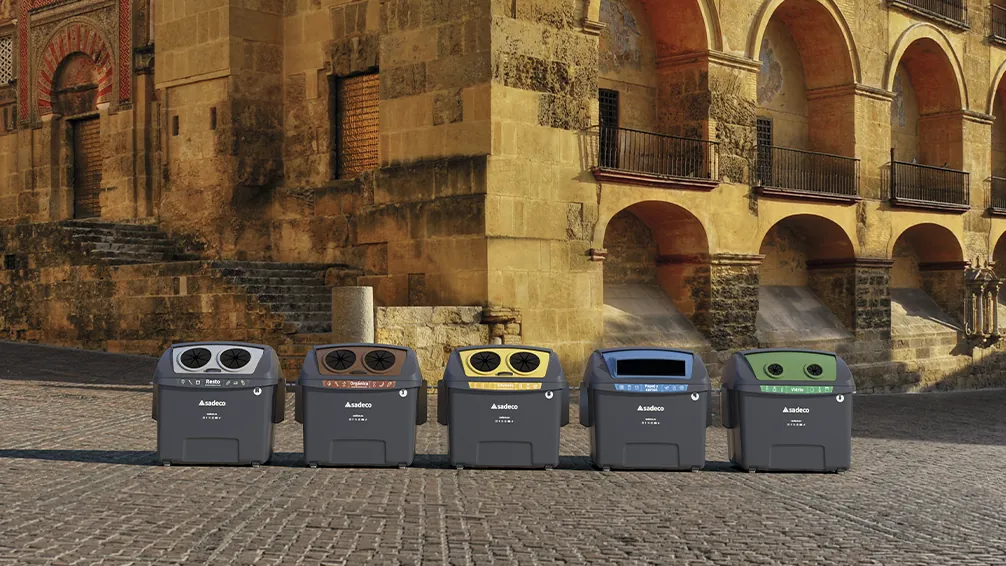
CONTENUR designed an exclusive family of containers for Madrid, incorporating eco-design and circular economy principles throughout the product’s lifecycle.
The project was built around four fundamental pillars:
- Redesigning models based on sustainability and usability criteria.
- Recycling materials to manufacture new equipment.
- Repairing and maintaining containers through specialized services.
- Renewing components independently to extend service life.
This philosophy maximizes equipment durability, reduces resource consumption and minimizes the environmental impact associated with fleet renewal.
A Project of Extraordinary Scale
The size of the contract reflects the complexity of the service.
CONTENUR provides service across Madrid’s 21 districts, serving more than three million residents through a dedicated organization designed to ensure maximum operational efficiency.
Some of the project’s key figures illustrate its scope:
- €148 million contract.
- Six-year duration.
- More than 200 professionals dedicated to the service.
- More than 100 specialized vehicles.
- Dedicated facilities exclusively assigned to contract management.
- More than 30,000 high-capacity containers.
- More than 280,000 individual-use containers.
- Deployment and maintenance of underground container systems.
In addition, during the first year of execution, more than 75,000 individual-use containers, more than 19,000 four-wheel containers and more than 30,000 high-capacity containers were renewed.
The Key to Success: A Fully Digitalized Service
Managing an operation of this scale requires much more than resources.
For this reason, CONTENUR committed to the complete digitalization of services, making data the central driver of decision-making.
All incidents reported through municipal platforms and citizen communications are analysed and managed through digital systems that enable every intervention to be planned, executed and monitored in real time.
This management model offers a fundamental advantage: the ability to respond quickly, efficiently and on the basis of objective data.
The information generated makes it possible to identify trends, anticipate needs and continuously optimize the resources allocated to the service.
A City That Never Stops
Madrid never stops, and neither does its containerization service.
To guarantee the permanent availability of equipment, CONTENUR operates with a service model that is active 24 hours a day, 365 days a year.
The operation includes:
- More than 1,500 incidents managed every week.
- Resolution of approximately 400 incidents per day in less than 48 hours.
- More than 2,400 weekly calls handled by specialized teams.
- Daily mechanical washing routes for side-loading and rear-loading containers.
- Services delivered through morning, afternoon and night shifts throughout the year.
- Intensive cleaning and preventive maintenance programmes.
This approach ensures that containers maintain optimal operating, hygiene and safety conditions regardless of district or usage levels.
Sustainability Applied to Urban Management
Sustainability is not limited to container design.
It is embedded throughout the project strategy.
The manufacturing of new models incorporates recycled materials, reusing approximately 600 tonnes of material to produce new equipment. In addition, the modular design allows specific elements to be replaced without replacing the entire container, reducing resource consumption and waste generation.
This is complemented by the implementation of processes designed to improve separate waste collection and promote the circular economy across the city.
The result is a more efficient, more sustainable system, prepared to meet the environmental challenges of the coming decades.
Accessibility, Quality and Continuous Improvement
One of the project’s defining features has been its commitment to universal accessibility.
CONTENUR has carried out specific audits of all containers across the city and implemented platforms, guiding elements and features that make them easier for any citizen to use.
At the same time, a continuous improvement model has been promoted based on:
- Service quality plans.
- Process automation.
- Real-time updated inventory management.
- Continuous monitoring of operational indicators.
- Regular performance evaluations.
This model enabled the project to achieve a service excellence level of 85%, certified by accredited entities.
Results That Transform the City
The combination of design, service, sustainability and technology has delivered tangible improvements across the city.
Among the most significant results are:
- Optimization of public space through the creation of complete recycling islands.
- Increased separate waste collection.
- Improved accessibility for citizens.
- Higher-quality data for municipal management.
- Greater public awareness through information and recycling campaigns.
- Continuous improvement in operational efficiency and service levels.
A Benchmark Model for the Cities of the Future
The Madrid project demonstrates that urban waste management goes far beyond the installation of containers.
It is about combining design, technology, sustainability and service to build cleaner, more accessible and more efficient cities.
At CONTENUR, we understand that every container is part of a much broader strategy: improving the citizen experience and contributing to the development of cities prepared for the future.
Today, Madrid is an example of how collaboration between public authorities and private companies can transform urban management on a large scale.
Because when design and service come together, the city works better.